
Woven vs Embroidered Patches: Which One Fits Your Design?
The woven vs embroidered patches question comes up on almost every patch enquiry we answer, and it deserves ten minutes of thought before you approve artwork. Both types are thread and fabric. Both will sit on a jacket, a cap or a kit bag for years. But they are built in completely different ways, and that changes how much detail you get, how the surface feels, how the patch survives washing and what it costs at volume.
Short version: an embroidered patch stitches thicker thread onto a base fabric, so the design sits proud of the surface. A woven patch interlaces fine threads on a loom, so the design is the fabric. Everything else follows from that.
The construction difference: thread stitched onto cloth vs thread woven as cloth
Embroidered patches start with a base cloth, usually twill. Computer-controlled embroidery heads then stitch polyester thread across that base, layer on layer. Satin stitches handle borders and lettering, fill stitches cover wider areas, and the finished design sits visibly above the twill. Run a fingertip over it and you feel ridges. Add a foam layer underneath and you get the raised 3D puff look that trucker caps and letterman jackets wear so well.
Woven patches skip the base cloth. Warp and weft threads are interlaced on a loom so the artwork is formed by the weave itself. Those threads are much finer than embroidery thread and packed tightly, and the result is one flat sheet where the design and the substrate are the same thing. Nothing sits on top of anything.
That single difference explains every practical trade-off below. Embroidered patches also have a long history in military and club insignia, which is part of why they read as traditional rather than modern (the history of the embroidered patch covers that ground well).
Detail and small text: where woven usually wins
An embroidery stitch is a physical object with width. Once lettering drops below a couple of millimetres tall, the stitches start to close up. Counters fill in. The gap inside an e or an a disappears. Thin outlines blob together, and fine parallel lines turn into one thick line. Your embroidery supplier will either thicken the type, drop the smallest element or tell you the design needs simplifying. All three are normal, and none of them is a fault.
Woven patches hold fine type, tight registration and thin strokes much better, because the loom can place far smaller threads per millimetre. Small text, hairline rules, tiny stars, a full web address across the bottom of a logo: these are woven patch territory. Gradients and subtle colour shifts also reproduce more cleanly in a weave than in thread.
A blunt opinion, then. If your design is a logo plus a strapline or a website in small caps, do not embroider it. Either switch to custom woven patches or redraw the artwork so it works in stitch. We have seen plenty of on-screen mock-ups where the small copy looked fine and vanished on the stitched sample. Fix that in the artwork stage, not after the bulk run.
Texture and appearance: raised and crafty vs flat and precise
Embroidered patches feel like something. The thread catches light at different angles, the surface has depth, and the edge can be finished with a thick merrowed border that gives the patch a chunky outline. On a cap front, a jacket back or a club blazer, that texture is the point. It reads handcrafted, a little retro, and it photographs with character.
Woven patches feel smooth and sit almost flush with the garment. Colours are consistent across the surface, edges are usually laser cut or heat cut and very clean, and the whole thing looks tidy and deliberate. For a corporate mark, a small chest logo or a minimal brand wordmark, that flatness looks sharper. Some buyers describe woven as looking printed. It is not printed, but the visual language is closer to print than to embroidery.
Here is the honest split: at small sizes, woven usually looks more precise. At large sizes, embroidery has more presence. A 20 mm woven tag looks expensive. A 20 mm embroidered tag can look cramped.
Durability: two different failure modes
Both types last. They just fail in different ways, and knowing which way matters if the patch lives on workwear.
Embroidered patches are a build-up of thick thread, so they shrug off abrasion and keep their shape. The weak point is snagging. A loose loop catches on a strap or a seat belt, pulls, and once a thread is drawn out the design starts to unravel. Fine detail is also the first thing to blur over months of washing.
Woven patches resist internal fraying because the weave is tight, and they hold up well on items that get handled constantly, which is why they suit uniforms, outdoor gear and bags. The trade-off is thinness. A fine weave has less bulk to give away, so on a high-friction area it can thin out where embroidery would have held a chunky cushion of thread.
Border finish matters as much as the patch body. Merrow overlock, heat cut, laser cut and die cut all behave differently at the edge, and the edge is where most patches start to go. Thread choice matters too: polyester, the standard for both types, is strong, holds dye well and handles moisture far better than cotton, which is why it dominates patch production (see polyester fibre properties).
One more thing. The adhesive usually fails before the patch does. Peel-off is nearly always a backing problem, not a stitching problem.
Cost: what actually drives the quote
Embroidery pricing tends to follow stitch count, thread colour count, patch size and backing. More colours mean more thread changes and more machine time. Dense, detailed artwork means more stitches. So a complicated embroidered patch gets expensive in a way a woven one does not, because in a weave extra colours cost comparatively little once the loom is set.
Woven pricing is dominated by the setup, the jacquard file and the weave, and then by run length. Our technical notes put it the way most patch factories would: embroidery is the flexible option at small quantities, and woven can work out more economical at large quantities. Do not assume woven is cheaper across the board, though. Ask for both quotes at your real quantity and compare the total landed cost, not the unit price.
Also worth knowing: when you reorder the same design, we do not charge the tooling fee a second time, and we keep tooling on file for two years.
Best uses: uniforms, hats, merch and club kit
- Workwear and uniforms. Name tapes, job titles, ranks and small text belong in woven. Larger crests, emblems and shoulder badges read better embroidered, and rank and title insignia for uniform programmes is work we do regularly.
- Caps and hats. The front panel is embroidery country, especially 3D puff. Woven works nicely on the side and back panels, and on any cap carrying a small flat wordmark.
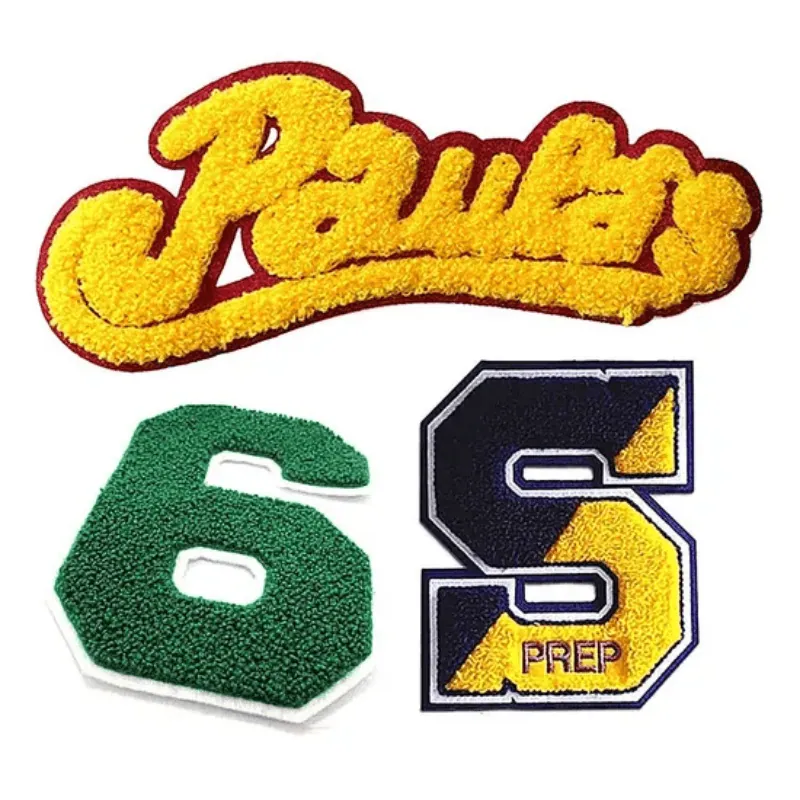
- Retail and brand merch. Woven for tight brand marks and detailed artwork. Embroidered for vintage, varsity and heritage styling, and pair it with chenille for letters (our chenille patch guide explains that option).
- Clubs and societies. Crests and shields with embroidered texture are the tradition. If the crest carries a motto, a founding year or a fine laurel detail, put the lettering in woven.
- Tactical and outdoor. Hook and loop morale patches are usually embroidered, and we also produce reflective and IR tactical hook and loop patches for kit that needs to be seen.
- Bags, denim and DIY. Large embroidered appliques and motifs, easy to iron or sew on.
Denim and heavy canvas do well with either. Nylon shells and anything that will be ironed hot need more care, and that takes us to backings.
Comparison table: embroidered vs woven patches
| Attribute | Embroidered patches | Woven patches |
|---|---|---|
| Construction | Thick thread stitched onto twill or felt base | Fine threads interlaced on a loom, no base cloth |
| Surface | Raised, textured, 3D puff available | Flat, smooth, consistent |
| Fine detail | Limited, artwork often simplified | Strong, holds fine lines and tight shapes |
| Small text | Poor below a few millimetres | Good, handles compact lettering |
| Look | Traditional, handcrafted, high presence | Modern, precise, close to printed |
| Durability | Resists abrasion, can snag and pull | Resists fraying, thinner under heavy friction |
| Edge options | Merrow, heat cut, laser cut, die cut | Laser cut, heat cut, die cut |
| Cost at low quantity | Usually lower and more flexible | Setup can weigh heavier on small runs |
| Cost at volume | Rises with stitch and colour count | Often the more economical choice in bulk |
| Typical use | Cap fronts, crests, jacket backs, morale patches | Name tapes, uniforms, small brand marks, detailed logos |
Backing options: match it to the garment, not the artwork
This is where buyers get caught out. The right backing is decided by where the patch goes and how it will be washed, not by how the front looks.
| Backing | Best for | Watch out for |
|---|---|---|
| Sew-on (plain) | Jackets, kit bags, thick cotton, anything long-life | Needs a tailor or a machine, so a slower fix |
| Iron-on / heat seal | Cotton, poly-cotton, denim, flat seams | Heat can mark synthetics, poor on nylon and on gear that gets hot |
| Hook and loop | Tactical kit, uniforms, removable and swappable patches | Adds bulk, needs a loop panel on the garment |
| Adhesive (self-stick) | Events, samples, packaging, temporary branding | Not permanent, generally one wear |
| Plastic or non-woven | Giving an embroidered patch structure and a stiff hand | Firmer feel against the body |
The standard backing options across our patch range include heat seal and iron-on, plastic, non-woven, adhesive and hook or loop fastening. If the patch is going onto a softshell, a waterproof shell or a stretch performance fabric, say so at quoting stage.
Can you combine the two? Yes, and it often solves the problem
Mixed construction is common on club and corporate work. A woven centre panel with an embroidered border gives you readable small text plus the chunky outline buyers expect. Chenille letters with embroidered outlines, or embroidered shapes with a woven text strip, work the same way. Printed and PVC patches are the other route when the artwork is photographic or needs moulded relief, and our PVC vs embroidered comparison covers when that makes sense.
If you are still deciding, ask for a quote on both. A supplier who pushes one type before seeing your artwork is selling stock, not solving a problem.
How to start an order with us
Send the artwork and the brief. Adobe Illustrator or CorelDRAW files are ideal, with colours referenced to Pantone Solid Coated. Tell us the finished size, the quantity, the backing you want and where the patch will be worn, and our team will come back with a free design mock-up and a quote. Samples usually take 3 to 8 days and bulk production 7 to 15 days depending on the item.
We accept custom orders regardless of order size, so a 50-piece club run and a multi-thousand piece uniform programme both go through the same process, with QC before anything leaves the factory. Payment is by T/T, L/C or PayPal. Yiwu TianYao Craft Co., Ltd. is part of a group with over 40 years in metal crafts and its own lanyard and PVC factories, which helps when a patch order turns into a full merch programme.
Start at custom patches, browse woven patches, or email [email protected]. You can also call or message +86 181 2281 1289, or use the contact page and we will reply within 8 hours.
Frequently asked questions
Are woven patches more durable than embroidered patches?
They fail differently rather than one being plainly stronger. Woven patches resist fraying because the weave is tight, which suits uniforms and gear that gets handled daily. Embroidered patches have thicker thread that takes abrasion well but can snag and pull. Border finish and backing usually decide how long either one lasts.
Can I put small text on an embroidered patch?
Only to a point. Stitches have physical width, so lettering below a couple of millimetres tends to fill in and thin lines merge. Your options are to thicken the type, drop the smallest element, or switch the design to woven, which holds fine text far better.
Which is cheaper, woven or embroidered patches?
It depends on quantity and design. Embroidered patches are usually the more flexible and affordable choice at small quantities. At larger volumes woven can work out more economical, because extra colours in a weave cost less than extra thread changes. Get both quoted at your actual quantity.
What backing should I choose for a patch on a jacket or cap?
For heavy cotton, denim and jackets, sew-on or iron-on are both fine. Iron-on is risky on nylon, waterproof shells and any fabric that cannot take heat, so choose sew-on or hook and loop there. Adhesive backings are for temporary use, not long-term wear.