
Breakaway Lanyards: When Your Event or School Needs a Safety Release
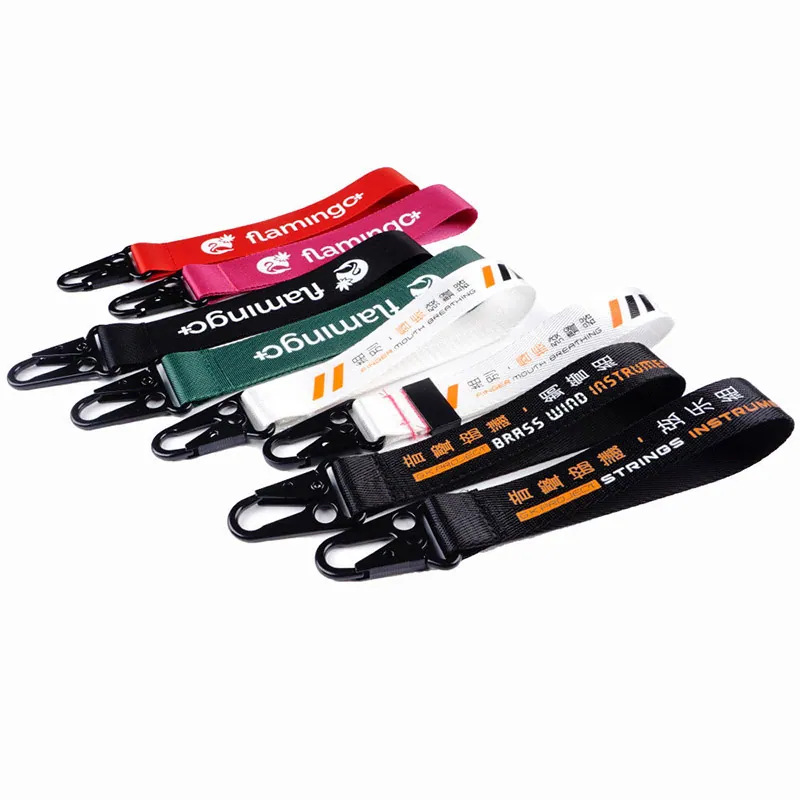
A breakaway lanyard is a neck strap with a buckle that pulls apart under load instead of holding on. That is the whole idea, and it is a small part with an outsized effect on what happens when something snags the strap. If your order is heading to a school, a race, a warehouse floor or a trade show hall, the buckle deserves ten minutes of thought before you approve artwork.
Most buyers start with webbing and print. Fair enough, that is what people see. A lanyard, in the general sense, is a cord or strap worn around the neck to hold something small (Wikipedia: Lanyard). What separates a good badge lanyard from a risky one is usually the fittings, not the colours. Here is how we think about it in our workshop, and what to ask before you place the order.
What a safety breakaway buckle actually does
A breakaway buckle sits on the strap, usually behind the neck or just off one shoulder, as two pieces that clip together and separate when the strap is pulled. Pull hard enough in the wrong direction and it pops. Snap it back together and the lanyard works again.
Two details matter more than any product page headline.
Release force varies. Buckles are not all built to the same tension, and a stiff one that needs a hard tug is not much use to a seven year old, while a loose one will pop every time someone leans over a table. Ask your supplier how theirs behaves, and if safety is the real reason you are buying, ask for a sample and pull it apart in your hands.
Second, a breakaway is only as good as the stitching either side of it. The buckle concentrates load on a short length of webbing. That is why our technical notes specify double-line reinforced stitching at the joints of a regular lanyard, and the same reinforcement belongs at the buckle ends, not just at the hook.
Schools and campuses: where the case is strongest
If there is one setting where the answer is almost always yes, it is a school. Campus cards, pickup cards, access cards, library cards, student ID. A lanyard around a child's neck is a loop, and loops catch on door handles, chair backs, bag straps and playground equipment.
Say you run a primary school issuing 600 campus card lanyards this term. The question is not which print looks best on the tape. It is what happens when a Year 3 pupil catches the strap on a door handle on the way out to break. A breakaway does not stop the snag. It gives the strap a way out.
Kindergarten and primary orders usually pair the buckle with softer webbing, because the strap sits on skin for six hours a day. Nylon is the common pick: soft, smooth, resistant to repeated bending, and it does not rub the neck the way a stiffer tape can. Heat transfer webbing is the cheaper option and perfectly reasonable for secondary schools and colleges, where the strap is worn in shorter bursts.
One honest caveat. A breakaway buckle is one layer of a sensible setup, not a licence to hand neck straps to unsupervised four year olds. Schools that think hardest about this pair a soft strap, a breakaway and a light badge clip rather than a heavy metal hook.
Events and races: credentials that survive the day
Race packs, finish line crew, marshal vests, trade show floor staff, festival volunteers. Breakaway buckles turn up here for a different reason. Staff spend the day moving through crowds, ducking under tables, lifting boxes and climbing in and out of vans. A credential that comes off under a snag is a credential you do not have to cut off someone's neck.
There is a second, less obvious benefit. Re-clipping means the lanyard survives the day and goes home with the person wearing it. Event lanyards have a long afterlife as souvenirs, and a buckle that clicks back together keeps that souvenir usable rather than heading for a bin bag on the Monday after.
For timed races, keep one thing straight: a credential lanyard is not a timing device, and a breakaway strap is not where you put a chip that must stay attached. If the chip has to stay on, that is a different product decision (ankle strap, wristband, shoe tag), and it is worth saying early rather than discovering it in the pack.
Workplaces around machinery and moving equipment
This one needs care, so we will be blunt. In any workplace with rotating equipment, conveyors, moving machinery, hoists or site vehicles, a neck lanyard is a decision for the site's safety lead, not for the marketing team. Many sites ban neck straps outright and use armbands, retractable reels or clip-on badges instead. If your client is one of those sites, sell them what they asked for.
Where a neck lanyard is worn, a breakaway is the sensible default. It also matters in less dramatic places: warehouse aisles, hospital equipment trolleys, kitchen pass-throughs, loading docks, photography studios full of light stands and cables. Anywhere a strap can be caught by something that moves while the wearer does not.
Outdoors, the same logic applies to gear straps for water bottles, keys and small tools. The fitting choice then splits: a carabiner or hook where the risk is dropping, a breakaway where the risk is snagging.
The trade-offs nobody puts in the quote
- Unit cost. It is an extra component on every strap. Small per piece, noticeable across five thousand.
- Accidental release. Cheap buckles either release too easily or not at all. Test before you approve the bulk run.
- Print area. The buckle interrupts the tape, so long wordmarks and full length artwork need adjusting around it.
- One more thing to break. A mechanical joint is usually the first point of failure on any strap, which is why the stitching matters more than the buckle brand.
- It is not a substitute for a risk assessment. It reduces one specific hazard. It does not make a neck strap suitable for every environment.
Which settings actually need one
| Setting | Add a safety breakaway? | Why |
|---|---|---|
| Primary and secondary school campus cards | Yes | Worn all day by children, with snag risk from doors, chairs and playground equipment |
| University and college ID | Usually yes | Same logic, lower risk, small cost per unit |
| Race crew and event staff credentials | Yes | Constant movement, loading and crowds; re-clips and survives the day |
| Trade show attendee badges | Optional | Short wear time; a nice upgrade rather than an essential one |
| Office employee badges | Optional | Low snag environment; comfort is the usual driver |
| Plant floor near moving machinery | Check site rules first | Many sites ban neck lanyards entirely |
| Outdoor gear and pet leads | Depends on the risk | Snagging and dropping need different fittings |
Webbing first, then the buckle
The strap carries the brand and the comfort, and it also has to survive the buckle. Five webbing types cover most orders we quote:
- Heat transfer webbing. The workhorse. Tight, abrasion resistant, holds colour in sunlight, cheapest at volume.
- Nylon. The toughest of the group, soft on the neck, moisture and corrosion resistant, higher unit price. Nylon is a polyamide, and that fibre family is why it takes repeated bending better than a basic polyester tape (Wikipedia: Nylon).
- Hollow (tubular) webbing. Two layers woven as one piece with a channel inside. Thicker and rounder at the same width, spreads load, and can carry a cord or elastic through the middle.
- Jacquard webbing. Logo woven into the tape, so it cannot flake or wash off. Premium look, no colour gradients, longer tooling, not a small-run option.
- High speed webbing. Flat surface, neat edges, solid colours and simple stripes, good for high volume at low cost.
Widths run 10, 15, 20, 25 and 35 mm, thickness 0.8 to 1.5 mm, standard circumference 90 cm (45 cm when worn). Standard lanyards can reach 120 N breaking strength and above, which is the number that reassures a procurement team and means very little if your real problem is snagging. More on sizing sits in our lanyard size guide.
Print method decides where the buckle can go
Screen printing gives saturated colour and strong adhesion, best for one or two colour logos and short slogans. It cannot do gradients, and very fine lettering gets soft. Heat transfer and dye sublimation handle multicolour artwork, slight gradients, cartoon characters and event graphics, with a flat surface that will not scratch a shirt collar. Jacquard weaving puts the logo inside the tape itself, the most durable answer and the least flexible one when artwork changes every season.
Now the practical bit. That buckle sits somewhere on your print. Put it behind the neck and you split the logo. Move it just off one shoulder and the front of the strap stays clean while the buckle hides in the curve. Decide this before the artwork goes to the printer, not after. Send files as AI or CorelDRAW with Pantone Solid Coated references and there is far less back and forth.
How to specify a safety breakaway lanyard
Write these down and most of the questions answer themselves:
- Setting and wearer age. A school strap and a race crew strap are not the same product.
- Webbing type and width. 15 or 20 mm covers most badge orders; 25 mm for events and outdoor work.
- Finished length, plus buckle placement (back of neck or offset shoulder).
- Print method, matched to the number of colours in your logo.
- Buckle type and release feel, checked on a physical sample.
- End fitting: metal hook, plastic lobster clasp, badge clip, carabiner, retractable reel.
- Reinforcement at every joint, including the buckle ends.
- Quantity, packing, labelling and destination port or address.
Short mobile straps and phone straps are a different construction from a neck lanyard, so say which you want before samples are made.
Starting an order with us
Yiwu TianYao Craft Co., Ltd. is a branch of a group that started in military manufacturing and has spent over 40 years in metal crafts. We run our own lanyard factory and PVC factory, which means the webbing, printing, fittings and packing stay under one roof rather than bouncing between traders.
Send us artwork or a rough sketch, the setting, the quantity and your deadline. Design work is free, custom orders are accepted regardless of order size, and samples usually take 3 to 8 days. Bulk production runs 7 to 15 days depending on the item, with express options for urgent event dates. Payment is by T/T, L/C or PayPal, and our QC team checks the goods before they leave the factory.
Email [email protected] or call +86 181 2281 1289 (also WhatsApp). The office is at Room 608, 6th Floor, Building A, Shuguang International Building, Futian Street, Yiwu, Zhejiang, China. You can also use the contact page and tell us what the strap has to survive. Browse the custom lanyards range for shapes and fittings we have made before, including a safety lanyard with a keychain fitting and full colour printed polyester lanyards.
Frequently asked questions
Is a breakaway lanyard the same thing as a safety lanyard?
Usually, yes. "Safety lanyard" is a loose term buyers use for any strap with a release feature, and the breakaway buckle is the most common version. Some suppliers also mean a strap with a reinforced clip or a high breaking strength, so it pays to describe the exact buckle you want rather than just the label.
Will a breakaway buckle pop off during normal wear?
A well chosen one should not. Release tension varies between buckle models, so decide based on who wears the lanyard and how. A school strap for young children wants a buckle that releases easily; a warehouse strap wants one that stays put through lifting and leaning. Always test a physical sample before a bulk run.
Can we add a breakaway buckle to a lanyard design we already have?
Yes, in most cases. The two things that change are the buckle placement in your artwork and the reinforcement stitching at the buckle ends. Send the existing artwork and we can show you where the buckle fits and how the logo should shift around it.
Does a breakaway buckle cost much more per unit?
It is an extra component, so it adds to the unit price, though the amount depends on the buckle model and the total quantity. We quote line by line so you can see the difference between a plain strap and a breakaway version before you commit.