5K Race Medals: Planning Custom Finisher Medals for Your Event
Custom 5k race medals are the one item every finisher takes home, photographs and keeps long after the results are posted. Order them late and you accept whatever the factory can rush out. Order them well and your race medals start recruiting for next year's event. What follows is the order a race director actually works through: timeline first, then design, metal, ribbon, quantity and packaging.
Build the timeline backwards from the start gun
Almost every late medal story starts the same way. The artwork sat in an inbox for nine days waiting for committee sign-off. Production was never the problem.
Our sample lead time is usually 3 to 8 days and bulk production runs 7 to 15 days, depending on the item and the craft involved. Shipping sits on top of that. Small or urgent orders move by express courier (DHL, FedEx, TNT, UPS); bigger ones go by air or sea. Then add clearance at your end, plus a day for your volunteers to count and sort boxes.
Say your 5K is on the second Sunday in October and you want medals in the warehouse two weeks before. Work back: two days of local distribution, a few days of international shipping, 15 days of worst-case production, 8 days of sample making, and a week of internal approval. That puts your brief in the supplier's inbox around two months out. If your committee only meets monthly, add another month.
Two calendar traps. Public holidays in China (National Day in early October, Chinese New Year in January or February) can close factories for days, and your event date will not move to accommodate them. Every design revision also restarts the clock, so collect all feedback in one pass.
| Stage | What happens | Typical time | What we need from you |
|---|---|---|---|
| Brief and artwork | Design draft: shape, layout, colours, text | Days; quicker with clean vector files | AI or CorelDRAW file, Pantone Solid Coated references |
| Sample | Physical sample made for approval | 3 to 8 days | One consolidated round of comments |
| Bulk production | Tooling, casting or stamping, polishing, plating, colouring, baking | 7 to 15 days, depending on craft and quantity | Written approval of the sample and the quantity |
| QC and packing | Inspection before goods leave the factory | Runs inside the production window | Confirm bagging and carton labelling |
| Shipping | Express for small or rush orders, air or sea for volume | Days by express; weeks by sea | Delivery address and customs paperwork |
| Buffer | Your insurance against the unexpected | 1 to 3 weeks | Resist the urge to spend it |
Design choices that move both price and lead time
Every medal starts as a shape. A round or oval blank keeps cost and time down. A bespoke outline (your bridge, your mountain, a shoe silhouette) needs its own cutting die, and internal cut-outs need an extra die again. That is a one-off cost, not a per-piece one, which is why a custom shape barely shows up on a large order and shows up painfully on a small one.
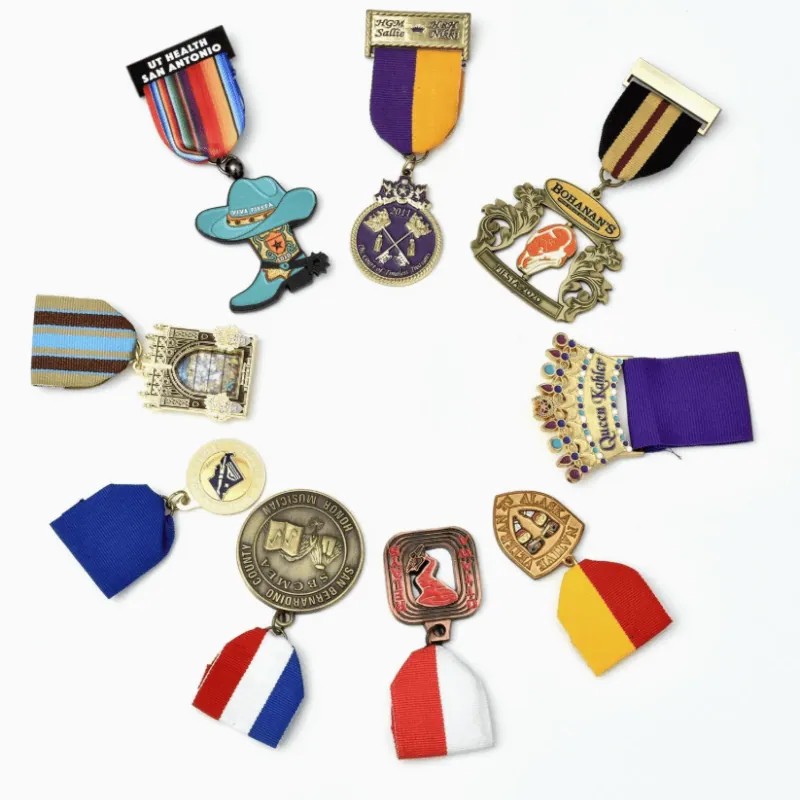
Relief is the next lever. Flat 2D artwork with colour fills is the quickest route. Shallow embossing gives lettering some lift. Full 3D die-cast relief, a runner's torso rising out of the medal face, needs a more complex mold and more polishing, and you can feel the difference in your hand. Both sit within our standard range of custom sports medals.
Then the moving parts. Foldable designs, like our foldable clover medal and the calla lily version, use a hinge, so there is assembly time in the quote. Spinner medals, where a centre disc rotates inside the ring, are popular for race series; many factories offer them, and it is worth asking whether the spinning insert is made in-house or bought in, because that decides who fixes it when something rattles. Double-sided designs double the colouring work. Hard enamel, fired one colour at a time, is slower than soft enamel and costs more, but it sits flush and survives a decade of handling. More detail on the trade-offs lives in our custom race medals guide.
Text is where designers get into trouble. Cast or engraved lettering reads well at a decent size. A five-line block carrying the date, a sponsor, a chip time and a charity line turns to mush. Pick the three things that matter and set them large.
Metal and plating: where the budget quietly goes
Most custom finisher medals are zinc alloy, die cast. Zinc alloy (often a Zamak-type alloy) fills a mold cleanly, takes fine detail and handles complicated 3D shapes at a sensible cost, which is why it dominates the category. Brass and copper feel heavier and stamp crisply, and they cost more. Iron is the cheapest route and looks fine under plating as long as nobody compares it side by side. Stainless steel 304 or 316 is the tough option for trail and obstacle events.
Plating is a two-line decision: gold, nickel, copper, bronze, antique or satin, and then how much shine you want. Antique and satin finishes hide the scuffs that come from being tipped out of a box and passed along a table, which matters on a wet race morning. Gold and polished nickel look spectacular in the pre-race photo and show every fingerprint. A good example of the antique look in our range is the bronze MTB championship medal.
Get the plating and colour spec written onto the approved sample, and keep that sample. When the reorder comes around, "same as last year" only works if someone still has the physical piece in a drawer.
On compliance: the enamel pigments used in our pin production are tested for total lead content against US CPSIA HR4040. That is a pigment test, not a whole-product certificate. If your event needs paperwork for a specific market, raise it at the brief stage so we can tell you plainly what is and is not available.
Ribbons, lanyards and how the medal hangs
Our lanyards come in 10, 15, 20, 25 and 35 mm widths, 0.8 to 1.5 mm thick, with a standard 90 cm circumference (45 cm when worn). Standard lanyards reach 120 N breaking strength, a comfortable margin for a medal that gets yanked at the finish line. We run our own lanyard factory, so ribbon printing is quoted alongside the medal instead of being sourced separately. Browse the range under custom lanyards.
Decide the attachment before the sample: ribbon bar and jump ring, a clip, or a printed lanyard threaded through the loop. Sublimation printing handles full-colour ribbon artwork, including sponsor logos and a distance stripe. If your market expects safety-release fittings, ask at the brief stage, not after the sample lands. Our notes on breakaway lanyards and the lanyard size guide cover the practical side.
Quantity, reorders and the mold you keep
Custom orders are accepted regardless of order size, and we do not publish a fixed minimum. A first-year race with a few hundred finishers is a normal starting point. What changes with quantity is the arithmetic on tooling: a bespoke outline, an internal cut-out or a deep 3D relief all carry a one-off mold cost that spreads across the pieces you order.
This is the part race directors underrate. Reorders of the same design carry no mold fee, and we keep molds for 2 years. For an annual 5K that is a genuine advantage: same silhouette, same weight in the hand, new year and new ribbon colour. Returning runners notice that continuity. If you plan to run the event beyond two years, say so at the start. A small date panel is far easier to revise than a year cast into the main relief.
Order a handful over your expected finisher count. Volunteers, sponsors, the mayor, the photographer and the person who lost theirs in the car park all want one.
Packaging so race-day handout does not become chaos
Standard options are poly bag, OPP bag, bubble bag and gift box, plus custom packaging sourced by our purchasing team. For race day the sensible default is one medal per poly bag, with lanyards attached or bagged separately depending on how many volunteers you have on the table. Attached saves time at the table. Separate lets you swap ribbon colours between distances at short notice.
Ask for cartons labelled with quantity and contents, packed in table order: 5K, 10K, junior race, volunteers. Say you have four tables and 600 runners arriving in ninety minutes. One sealed, labelled carton per table with a spare bag inside is the difference between a queue and a scrum. If you post medals to virtual runners, a bubble bag and a printed card in the same parcel beat two shipments.
How to start an order with us
Yiwu TianYao Craft Co., Ltd. makes custom metal crafts, sports medals and lanyards from Yiwu, Zhejiang, and we have been in metal craftsmanship for over 40 years. Send your race date, expected quantity, delivery address and whatever artwork you have (AI or CorelDRAW preferred, Pantone Solid Coated colours for reference). You get a free design draft and a quote, then a sample in 3 to 8 days.
Email [email protected] or call and message us on WhatsApp at +86 181 2281 1289. Sales is online 24 hours and replies within 8 hours. Payment is by T/T, L/C or PayPal. Start with the contact page, look through the full custom medals category, and read our production process so the brief you send covers everything in one go.
Frequently asked questions
How far in advance should I order 5K finisher medals?
Work backwards from race day. Samples usually take 3 to 8 days and production 7 to 15 days, then add shipping, customs and your own sorting time. For most events that means sending the brief roughly two months ahead, and longer if your committee approves designs slowly or your date lands near a Chinese public holiday.
Do I pay a new mold fee if I reorder the same medal next year?
No. Reorders of the same design carry no mold fee, and molds are kept for 2 years. Tell us at the start that the race is annual, and keep the approved sample so the plating, colour and weight can be matched exactly.
Is there a minimum order quantity for custom race medals?
Custom orders are accepted regardless of order size, and we do not publish a fixed minimum. What does shift with quantity is how far the one-off tooling cost spreads across each medal, so send your expected finisher count and we will quote against it.
Can you supply the ribbons or lanyards with the medals?
Yes. We run our own lanyard factory, so ribbons and lanyards can be quoted with the medals. Widths run from 10 mm to 35 mm at 0.8 to 1.5 mm thick, with a standard 90 cm circumference, and printing can carry your event colours and sponsor marks.